Business SIM Only Plans Compared: How to Choose the Right One (2026)
Prices are indicative, exclude VAT, and may depend on contract length, connection quantity and current promotional availability. Correct at the




Quick Answer: VodafoneThree is the UK’s new largest mobile network operator, formed in June 2025 following the merger of Vodafone UK and Three UK. If you’re an existing Three or Vodafone Business customer, your service continues as normal – but your phone now automatically connects to whichever of the two networks has the stronger signal at any given location.
After years of regulatory back-and-forth, Vodafone UK and Three UK merged in June 2025 to form VodafoneThree – now the UK’s largest mobile network operator, serving over 28 million customers across both fixed and mobile. The merged entity is privately owned, with Vodafone holding 51% and CK Hutchison Holdings the remaining 49%.
Both the Vodafone and Three brands continue trading separately for now. The contracts, customer support teams, and plan structures you’re used to haven’t changed. VodafoneThree is the shared legal entity operating behind both brands – think of it as the infrastructure and investment vehicle, rather than something customers interact with directly.
For business customers specifically, Three Business claims to serve over one million business accounts across the UK, making it one of the larger dedicated business networks in the country.
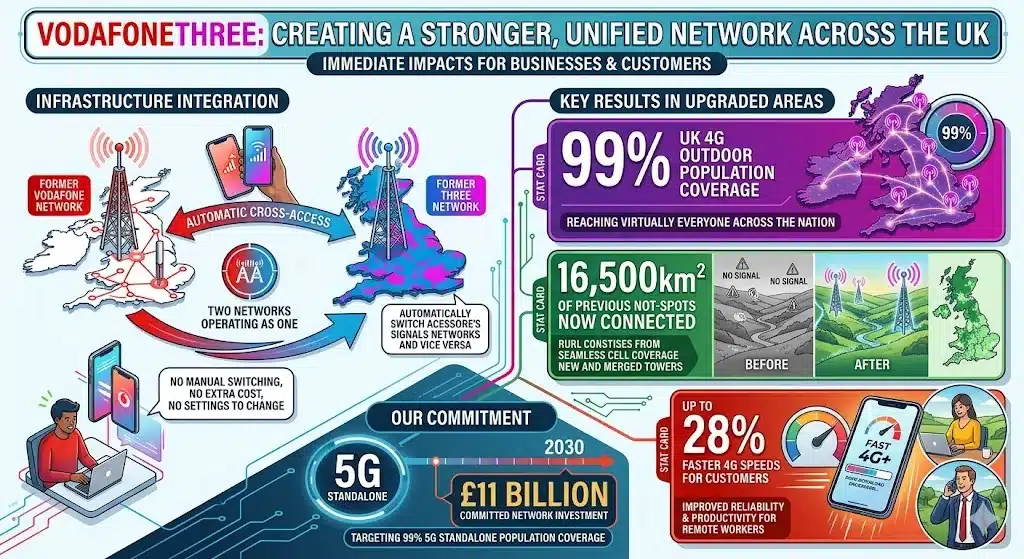
This is where the merger has the most immediate impact. Rather than operating two separate networks side by side, VodafoneThree has begun integrating its infrastructure – which means Three customers can now automatically connect to Vodafone’s network where it provides better signal, and vice versa. No manual switching, no extra cost, no settings to change.
According to Three Business, the practical results are already visible in upgraded areas:
For businesses with employees who work remotely, travel frequently, or operate in areas where Three’s standalone coverage was previously patchy, that last point is particularly relevant. The not-spot figure is significant – 16,500km2 is a substantial portion of rural and semi-rural UK that previously had little or no reliable signal.
The longer-term target, according to Three Business, is 99% 5G Standalone population coverage by 2030, backed by a committed £11 billion network investment.
For most businesses on Three or Vodafone, the honest answer in 2026 is: the improvement is real but still rolling out. Network integration takes time, and not every area has been upgraded yet. The headline coverage figures reflect the target state, not a fully completed rollout.
That said, several things are already in place and worth understanding:
Automatic network switching. Your devices connect to whichever of the two networks offers the best available signal at your location. This is particularly useful for businesses with staff spread across different parts of the country, or who regularly travel between urban and rural areas.
Fixed and mobile in one place. Three Business now sits alongside Vodafone’s full fibre network, which means businesses that need both a mobile fleet and fixed broadband connectivity can potentially manage both through a single provider relationship. You can explore business broadband options here.
5G broadband as a fixed alternative. Three’s 5G broadband product works without fixed infrastructure – no engineer visit, no physical installation. For businesses in locations where fixed broadband is unreliable or slow, or for teams that move between sites, it’s worth considering as a secondary or primary connectivity option.
Roaming across 163 destinations. Three Business roaming is structured across three tiers, with daily rates applying unless you’re on an Inclusive Roaming plan:
| Roaming Plan | Destinations | Daily Rate |
| Go Roam in Europe | 49 | £2/day |
| Go Roam Around the World | 22 additional (71 total) | £5/day |
| Go Roam Around the World Extra | 92 additional (163 total) | £7/day |
Businesses on qualifying 24-month Inclusive Roaming contracts have the daily charge removed entirely for their covered destinations. Plans can be mixed and matched per SIM, so roaming doesn’t have to be a blanket cost across every line on the account. You can view Three Business SIM-only plans here, including the Three Business Unlimited Data SIM and Three Business 80GB SIM.
Usage management – Three Analyst is Three Business’s built-in reporting tool, giving account managers visibility of spend and data usage at both account level (Standard) and per employee (Advanced). For businesses that have struggled to identify which lines are over- or under-used at renewal, it’s a practical tool for keeping mobile costs under control.
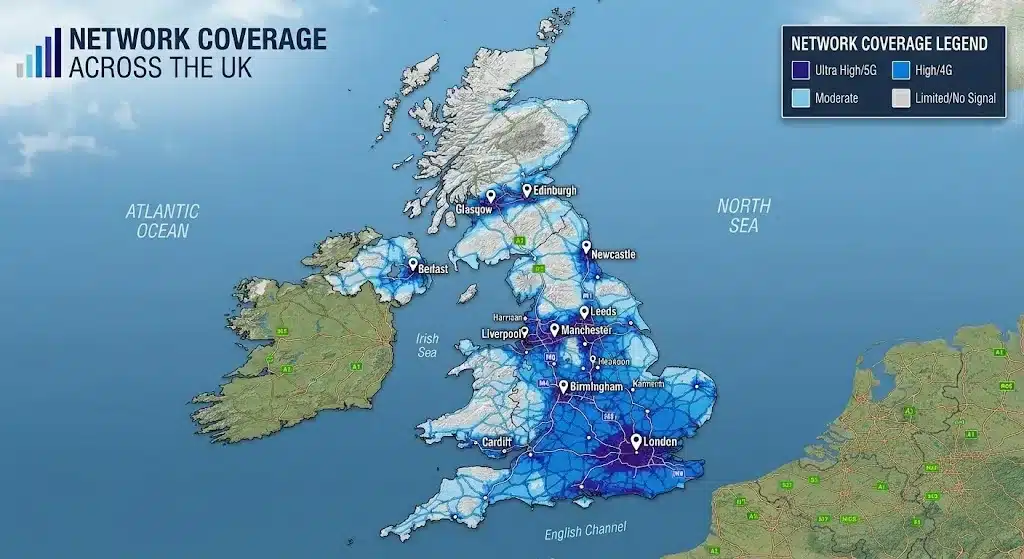
Want to check your network availability? Visit the Ofcom Coverage Checker here.
The merger is less than a year old. The coverage improvements Three Business describes are a combination of what’s already been delivered and what’s on the roadmap to 2030. Businesses evaluating Three Business today should check coverage at their specific locations rather than relying on national headline figures.
The 5G Standalone rollout – which promises better indoor coverage, lower latency, and the ability to segment parts of the network for specific business uses – is a genuine technological step forward, but it’s a 2030 target. In practical terms for most businesses in 2026, the most tangible benefit is the combined 4G coverage footprint and the speed improvements in areas that have already been upgraded.
It’s also worth noting that Vodafone and Three are still operating as separate customer-facing brands. There is no single “VodafoneThree” plan you sign up to directly – you’re still choosing between a Three Business contract or a Vodafone Business contract, both of which now run on the shared infrastructure. You can compare business mobile plans across all networks here.
Based on Three Business’s own materials, the case for choosing Three Business in 2026 is stronger than it was 12 months ago. The combined network footprint, the committed £11 billion investment, flexible roaming options across 163 destinations, and built-in account management tools make it a credible option for businesses of most sizes.
The questions worth asking before committing are practical ones: does the merged network cover the locations your team actually works from? Does the roaming structure match your travel patterns? And does the plan flexibility – voice and data or data-only, 30-day to 24-month terms, 3GB to unlimited data – fit how your business actually uses mobile?
If you’re a smaller business, our small business mobile plans page is a good starting point for comparison. For larger accounts, take a look at our corporate mobiles section. You can also use our mobile plan builder to find a plan matched to your usage.
At BusinessMobiles.com, we work with Three Business alongside EE, O2, and Vodafone, which means we can compare what’s available across all four networks against your specific usage. If you want to see how Three Business stacks up for your account, talk to us and we can run through the options.
If you’re considering Three Business as part of a new contract, renewal, or network switch, we can compare it against current deals on EE, O2, and Vodafone based on your actual usage. Talk to us and we’ll put together a clear comparison across all four networks. Or if you’d prefer to start exploring straight away, you can browse current Three Business SIM-only deals or use our mobile plan builder to find the right fit.


Business SIM Only Plans Compared: How to Choose the Right One (2026)
Prices are indicative, exclude VAT, and may depend on contract length, connection quantity and current promotional availability. Correct at the time of writing, June 2026.
iOS 27 For Business: New Features To Watch Out For
Most iOS updates install themselves before anyone in the business notices. iOS 27 matters more, because three of its changes touch decisions you actually have

What happens if you cancel a business mobile contract early?
Quick Answer: Cancelling a business mobile contract early will usually mean paying the remaining months of your agreement in full, including any outstanding device balance.

SIM Fleet Management for Business: What IT Managers Need to Know
Quick Answer: For IT managers, eSIM turns fleet management from a physical logistics exercise into a digital one. It enables zero-touch provisioning, remote line activation and deactivation, dual SIM