iPhone 18 Pro / Pro Max just landed. Limited stock. Order yours from £46/month >
iPhone 18 pre-order
iPhone 18 Pro / Pro Max just landed. Limited stock. Order yours from £46/month >

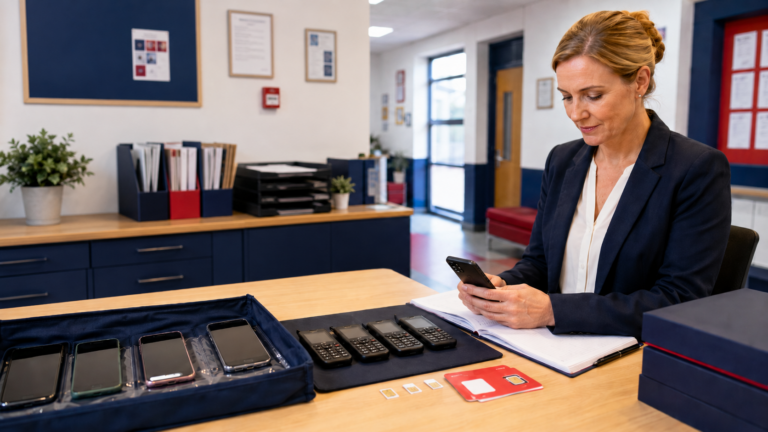
Since 29 June 2026, state-funded schools in England must be phone-free by default under the Children’s Wellbeing and Schools Act 2026. Replacing smartphones at scale means basic handsets plus the right child-safe SIMs, which one supplier can source and manage together.
KEY TAKEAWAYS:
recommends 💡
Don’t treat the phone and the SIM as separate jobs. Decide your safeguarding rules first, including whether data is blocked outright, then source the handset and SIM together so the setup is compliant from the first day of term.






Book a free 15-min call with a UK business mobile expert
The law on phones in schools changed on 29 June 2026, and making it work falls to business managers, procurement leads and MAT operations teams.
This post covers what the new duty requires, what a compliant alternative looks like once you account for both the handset and the SIM, and how one supplier can handle the sourcing.
Want a personalised recommendation?
Something significant just changed in UK schools, and most businesses haven’t clocked it yet.
Under Section 36 of the Children’s Wellbeing and Schools Act 2026, the Department for Education’s guidance on mobile phones now has the force of law. Since 29 June 2026, every state-funded school in England has had to have regard to that guidance, and it’s blunt: schools should be mobile-phone-free environments by default, with smartphones and anything with similar functionality (messaging, notifications, recording) off-limits for the entire school day. Exceptions only for things like medical or assistive needs.
This isn’t a school-by-school policy anymore. It’s law. And it creates a problem nobody’s talking about yet.
The Act places a legal duty on schools to have regard to the DfE guidance, rather than a flat ban on possession, but in practice it lands the same way: schools are expected to have a policy that keeps phones out of the school day. Ofsted now assesses how schools handle that policy at inspection, so it isn’t something a school can set once and forget.
Parents still want to reach their kids, and kids still need a way to get home safely. Schools can’t just confiscate every phone at the gate and call it done. They need a workable alternative, at scale, for thousands of pupils, that satisfies parents, safeguards students, and stays inside the law. That means sourcing basic, “dumb” phones (calls and texts only, no browser, no apps, no social media) in volume, reliably, and affordably. There’s almost a nostalgic moment in it: the answer schools are landing on looks a lot like the 90s mobile phone models many of us grew up with, before smartphones existed at all. Handsets like these are still made and start from under £20.
The device is only half of it, though. It also needs the right SIM behind it. There are already child-safe networks built for exactly this: no-data SIMs that allow calls and texts only, with “home numbers” that always get through even with no credit, and locked modes that restrict a phone to calling or texting a short list of approved numbers, useful when a school needs to be one of them. A few mainstream networks have started building dedicated under-18 plans too, with EE the first major UK network to do so. The right device paired with the wrong SIM still leaves a gap; getting both right is what actually solves the problem.
Compare EE, O2, Vodafone and Three with someone whose job is finding the right fit – not selling you their own product.
That is not a problem most schools are equipped to solve alone. It sits at the intersection of procurement, mobile network contracts, safeguarding policy, and device supply: four different specialisms that rarely sit in the same room, and most schools don’t have the time or the buying power to chase down each one separately.
BusinessMobiles.com is an independent UK business mobile specialist, working since 1999 across the four major UK networks: EE, O2, Vodafone, and Three. This is exactly what we already do. We source the devices, we supply the SIMs, and we handle the network side, so a school doesn’t need to run a separate conversation with a device manufacturer, a different one with a network provider, and another one to check it’s all safeguarding-compliant. One point of contact, one order, one supplier accountable for the whole thing working.
HSBM Facilities Management Ltd | 50+ employees
If you’re pulling a plan together for September, a few decisions come before the buying does.
If you’re trying to source compliant phones and SIMs at scale, this is a conversation worth having now.
Get in touch with our Head of Partnerships, Lucy Wilson.
Whether you need a single number or a full team of business mobiles, our experts will match you to the right setup – across all four UK networks.
If we’ve not covered your question here, Book A 15-Min Call with our team to talk about your mobile needs.
State-funded schools in England have a legal duty, under Section 36 of the Children’s Wellbeing and Schools Act 2026, to have regard to DfE guidance on mobile phones. That guidance says schools should be phone-free by default. In effect, schools are expected to have a policy that keeps smartphones out of the school day, with exceptions only for needs such as medical or assistive use.
A basic call-and-text handset with no browser, no apps and no social media is the simplest compliant option. Paired with a no-data SIM, it removes internet access at both the hardware and the network level, so there’s no route to social media or messaging apps during the day.
Through the school office for anything urgent, as has always been the case, and outside school hours on a basic handset. Some child-safe SIMs also provide “home numbers” that always connect even if the child has no credit left, and can be locked to a short list of approved numbers, which a school can be added to.
EE is the first major UK network to launch plans built specifically for under-18s, and Vodafone offers child-safe SIM options with content filtering. Specialist providers such as ParentShield focus entirely on child-safe SIMs, with no-data tariffs, home numbers and allow-list controls.
Buying direct means running a device order, a network contract and a safeguarding check as three separate jobs. One supplier sources all three, matches the SIM to your policy, and manages it as a single account, giving a school or MAT one point of contact accountable for the whole setup working across hundreds or thousands of pupils.
The law has changed, and the schools that handle it well will plan the alternative rather than react to it. The decision isn’t really about the phone or the SIM in isolation; it’s about matching both to your safeguarding policy and sorting it in volume before term starts. Get your rules straight, then bring the device, SIM and network contract together under one supplier. If you’d rather not run separate procurement conversations to get there, get in touch and we’ll handle it.
Practical advise to save on your bill, switching tips, and the latest deals worth knowing about. No spam.
Unsubscribe any time. We never share your email.
Two minutes is all it takes to start. Pick the path that suits you:
Send us your bill – we’ll spot the savings within 2 hours.

Expert in…
Lucy Wilson is Head of Partnerships & Growth at BusinessMobiles.com, with over a decade of experience across partnerships, business development and commercial growth.
She specialises in building partnership programmes from the ground up, identifying strategic opportunities and creating relationships that deliver genuine value for both organisations and their customers. Her experience includes developing corporate partnerships with major businesses such as Addison Lee and Specsavers, as well as building partnership models designed to support sustainable, long-term growth.
Lucy began her career over 20 years ago as cabin crew with Virgin Atlantic, where she developed a strong understanding of customer experience, communication and relationship-building. Her love of travel began there and continues to shape the way she connects with people and approaches new opportunities.
At BusinessMobiles.com, Lucy is focused on building a trusted ecosystem of organisations that support UK SMEs, creating commercial opportunities through collaboration and helping partners extend the value they offer to their customers.
Something many people don’t know about Lucy is that one of her labours of love is a pet supplement brand now sold in B&M, Home Bargains and Action stores across Europe. Lucy helped her partner bring the brand to life through her creative and partnership expertise.
Outside of work, she is mum to a 15-year-old son and splits her time between Manchester and Lincolnshire.
Enjoy this post? Share it with your colleagues

Download the fair price index
Pop your details in and we'll send the PDF straight to your inbox.
Unsubscribe anytime · data never shared with 3rd parties
The BusinessMobiles.com Fair Price Index is on its way to your inbox. Check your spam folder if it doesn't appear within a few minutes.
Download your free MDM platform flowchart
Pop your details in and we'll send the PDF straight to your inbox.
Unsubscribe anytime · data never shared with 3rd parties
Your free MDM platform flowchart is on its way to your inbox. Check your spam folder if it doesn't appear within a few minutes.
Download your free SIM-only plan flowchart
Pop your details in and we'll send the PDF straight to your inbox.
Unsubscribe anytime · data never shared with 3rd parties
Your free SIM-only plan flowchart is on its way to your inbox. Check your spam folder if it doesn't appear within a few minutes.